Wednesday, August 10, 2011

Patrick Leigh Fermor: A Reader's Appreciation


One writer who certainly did not need 250 pages to answer the question “Why read?” was Patrick Leigh Fermor, who passed away this June at age 96 and who, with a mere sentence or exactingly crafted phrase, could provide any sentient reader a compelling, unequivocal answer. On a single page Fermor could encapsulate as much elegance, passion and life as most writers manage to fit into a lifetime of writing. And if ever there were a monument to affirm the value of education, erudition, intellectual curiosity, and rationalism, it is the body of work Fermor left us, including, one eagerly hopes, at least another book to come, given reports of a draft manuscript that may at last bring to a close the journey to Constantinople on which he set out by foot from the Hook of Holland in 1933 at age 17 and, in the written record of his adventure, had yet to reach. I came to news of Fermor’s death the same way I came to his works: late. And while I know him only through the several books of his that I’ve read, the debt I feel to those works and to the person who wrote them is beyond measure. They opened for me entire worlds, and stand as a testament to the profound possibilities that life – and the life of the mind - can offer. Over the past two months I’ve felt increasingly remiss about letting go the passing of a writer so important to me without making some gesture of acknowledgement and gratitude. I can almost certainly best accomplish this by directing anyone still with me to the Patrick Leigh Fermor blog, where Tom Sawford has done a tremendous job in drawing together a great number of memorials and reminiscences that testify to Fermor’s remarkable life. By way of a more personal commemoration, I thought I'd embark on another of Fermor’s books, and chose his Mani: Travels in the Southern Peloponnese for Fermor’s obvious love of the region.

I’d heard of Patrick Leigh Fermor for years, but only last year finally decided, on a whim, to pick up A Time of Gifts. Having fallen under its spell, I quickly moved on to its sequel, Between the Woods and the Water, and then to A Time to Keep Silence. I’ve saved a few of his books for later, confident of the rewards they’ll inevitably provide and hesitant to get through all of them too quickly; riches like these need to be relished and given the patience they seem to gently request. Fermor’s writing - vastly informed and capacious, poetically keen, lyrically rapturous, of an astonishing linguistic agility and versatility - surpasses genre. His works are not just travel, history or art history, anthropology or sociology, not even what today might fall under the opaque rubric of “cultural studies.” They possess a literary quality that’s almost novelistic, with careful structuring, compelling narrative propulsion, memorable characters and a sense of forward movement marked by growth and expansion. Their attention to rhythm, meter, sound and structure can be as concentrated as that of serious poetry. Searching out a copy of Mani for a friend after having finished it myself, I found Fermor’s travel works both in the travel section of the bookstore and, as though they had migrated there on their own power, filed under “Fiction.” The store had plastered a sticker on the back of the NYRB copy I purchased categorizing it as “Travel Essay” - but calling Mani a mere travel essay is a bit like calling the Winged Victory of Samothrace a mere slab of rock.

Fermor’s accounts plunge one into realms that to outside eyes probably would have appeared exotic enough when he traveled through them, but which now, through the alchemy of time, exist in large part only as fictions, as jewel-like glimpses of disappearing or now bygone people, places and experiences.  It strikes me as perfectly congruent that Fermor wrote the preface to the English translation of Miklós Bánffy’s great Transylvania trilogy, as he shares with Bánffy a curious temporal distance from his subjects. A Time for Gifts, the first volume of Fermor’s 1933-36 journey from the Netherlands to Constantinople, saw publication in 1977, more than 40 years after the journey itself, just as Bánffy’s strongly autobiographical work, covering the first few years of the 20th century, was not written until the 1930’s. This distancing in time adds to an unearthly earthiness in these books. The places and people they describe, as palpable as in the best literature, at the same time appear as though viewed through a glass – though certainly more lightly than darkly, particularly in Fermor’s sun-drenched Mani, where he explores the people, geography and history of this wild, remote, southernmost peninsula of the Greek mainland – the place he chose to make his home for much of the rest of his life.

I can think of few other writers who have been so successful in stealing so much from time.  In recording aspects of the world in the process of their dissolution and/or disappearance, Fermor somehow manages to pin and hold them in abeyance, much as cold matter physicists have been able to stop and hold light for nanoseconds (this acute attention to the moment is helpfully underscored by Fermor’s having lovingly given a descriptive heading to each page of Mani) [i]. Beyond this powerful immediacy and vitality in his accounts, the rich history that he provides to bracket his personal experiences lends a an acute and pervasive awareness of time’s erasures, as in his preface to Mani, where he offers this partial justification for the book: “…between the butt of a Coca-cola bottle and the Iron Curtain, much that is precious and venerable, many living mementoes of Greece’s past are being hammered to powder. It seems worthwhile to observe and record some of these less famous aspects before the process is complete.”

Yet, not content to simply rail against the ravages of time, Fermor balances his disappointments with a sanguine and broad view of change. One senses in everything he writes a vital acknowledgment of the brevity of individual lives in the context of great movements of history, as well as an effusive delight in the intellectual challenge of tracing the tiniest of details back to their remote origins, in part to unsettle their sense of permanence, as, for example, in his gentle rebuke in Mani of those who would see the Greek language purged of its foreign influences, as it would dishonor history and “rob the rich spoken tongue of much of its stimulus and bite” (a point of view that might be stressed to language purists everywhere).  Fermor’s task, as he seemed to see it – “observing and reporting” – took the long view. I don’t know enough about his convictions to ascertain whether anyone might characterize this perspicacity and deep, respectful engagement as religious. His sojourns in monasteries detailed in A Time to Keep Silence suggest an attraction to the concept of spiritual retreat and development, but he seems to have spent this time in them largely out a desire to write in solitude, partly out of his unquenchable curiosity, and, at least in small part, as sober respite from his adventures. In any case, Fermor clearly felt towards the righteousness of the world’s religions much as he felt about linguistic purism, and repeatedly expressed a wistful appreciation of the old polytheistic worlds that were generous and receptive enough to welcome and incorporate other gods and beliefs, as opposed to a less morally accommodating monotheism he described in Between the Woods and the Water as being as inseparable from strife and conflict as “stripes from a tiger.”

One of the attractions to Fermor’s writing is his uncanny ability to create impressionistic passages, sentences and phrases stunning in their precision and bewitching in their beauty (not to mention – and I don’t think I’m being too unreasonably hyperbolic here - a capacity arguably unmatched by any English writer since Shakespeare of gleaning out of individual words unexpected facets and nuances of meaning). Even just the opening pages of Mani offer an abundance of such phrases, as in these few examples:

The sauntering loops of the Eurotas had shrunk now to a thread whose track was marked by oleanders opening cool green sheaves of spiked leaves and pretty flowers of white and pink paper over little more than the memory of water: a memory whose gleam, through the arid months to come, would keep their bright petals from languishing.

Wine-heavy sleep soon smoothed out these wrinkles of perplexity.

Felons on invisible treadmills, our labour continued through viewless infernos like the taste-shoots of lime-kilns…

A faint tinkle of bells from the abyss told that faraway goats were shaking off the mesmeric stupor of midday.

Fermor could also inject a remarkably subtle wit into his elegant sentences:

As the Taygetus range towers to eight thousand feet at the centre, subsiding to north and south in chasm after chasm, these distances as the crow flies can with equanimity be trebled and quadrupled and sometimes, when reckoning overland, multiplied tenfold.

Besides his precision of language, other aspects of Fermor’s erudition, so sharp and wide-ranging, inspire wonder at how he managed it all: his seemingly miraculous ability to keep centuries of historical family names at his fingertips; the comprehensiveness of his probing intelligence, equally adept, for example, at comparative studies of Byzantine ikons as at describing the glories of Mediterranean gastronomy; the dazzling ekphrasis, in one passage after another, of his appreciation of works and genres of art ranging over so many diverse styles and periods (I hope I don’t sound ungrateful in expressing a personal wish that such a prodigious mind and heart could have lived to explore still other corners of human experience; recently reading an amply fascinating account of late 19th and early 20th century archeological explorations of China’s Silk Road [ii], I nonetheless found myself wondering, with no small sense of loss, at what Fermor could have done with such provocative historical material). Yet at times, Fermor’s passion for the mind also carries him on fantastical elaborations almost exactly opposite to the dense, exactingly researched investigations of history, art history, and genealogy that mark so much of his writing, such as in the lengthy section of Mani that comes off as an extemporaneous, multi-page improvisation on the migrations of the world’s birds (birds often seem to invite Fermor to take off on wild flights of fancy; I can’t help but wonder whether his account of an old man in the village of Layia finding a quail tagged with “42, Rue Lenormant, Paris” is either an inside joke or pure invention, since I can find no reference to any such street ever existing in Paris).

At times his appreciation for an artwork, a person, a place or even some abstract element also inspires these free-form riffs, saturated with the sheer joy of literary invention and expression (every time I read him, I find myself compelled to copy down some such passage just for the pleasure of it):

The air in Greece is not merely a void between solids; the sea itself, the houses and rocks and trees, on which it presses like a jelly mould, are embedded in it; it is alive and positive and volatile and one is aware of its contact as if it could have pierced hearts scrawled on it with diamond rings or be grasped in handfuls, tapped for electricity, bottled, used for blasting, set fire to, sliced into sparkling cubes and rhomboids with a pair of shears, be timed with a stop watch, strung with pearls, plucked like a lute string or tolled like a bell, swum in, be set with rungs and climbed like a rope ladder or have saints assumed through it in flaming chariots; as though it could be harangued into faction, or eavesdropped, pounded down by pestle and mortar for cocaine, drunk from a ballet shoe, or spun, woven and worn on solemn feasts; or cut into discs for lenses, minted for currency or blown, with infinite care, into globes.

But the marvels of Fermor’s language aside, what makes his work so rich and affecting is the manifest, deeply genuine interest he conveys in not just the human experience, but also in human beings individually. His profound respect for and interest in others – be they rich nobles or poor fishermen, be the occasion a ceremonial dinner in a palace or the asking of directions from a young girl tending goats on a mountain path – comes across with a tremendous property of dignity, a recognition in each encounter of the mutual sharing of an unprecedented and never to return again moment of humanity amid the great sweep of history. All of Fermor’s meticulous intellectualism, his adventuring and his devotion to service, seem in him not points of pride, but rather an expression of a grand responsibility towards life itself, a firm, almost devotional stand against the indifference he viewed as “a sign of brutishness and a denial of human feeling.”  Though Fermor is no longer with us, his time of gifts appears nowhere near its end; like the miracle of the loaves and fishes, it promises to keep providing, offering the limitless pleasures and insights of reading a deep and generous mind, and reminding us that the effort to travel, to explore, to acquire knowledge of history, literature, languages, art, diplomacy and wit, and above all, of people, is not an end, but rather a means for participating more profoundly in, and sharing to the utmost with others, the marvels of the world in which we find ourselves.


[i] The NYRB edition of Mani preserves this pleasant feature; it’s a shame, though, that NYRB was unable also to preserve the wonderful black and white photographs taken by Joan Fermor that feature in the original edition of the book.
[ii] Foreign Devils on the Silk Road, by Peter Hopkirk

Wednesday, June 29, 2011

Pourquoi Lire?


First of all, I just have to mention to whom it may concern that the French literature section of the library needs some attention – eventually. But there’s no hurry; absent its current state of breathtaking disarray I’d have missed the happy hazard of picking up Charles Dantzig’s 2010 book Pourquoi Lire?. There I found it, carelessly crammed in face down on top of other books, not far from the gap once ostensibly occupied by the book I’d gone there to find, Dantzig’s Encyclopédie Capricieuse du Tout et du Rien (Capricious Encyclopedia of Everything and Nothing). And while clearly something should be done, I’m not altogether ungrateful for the mess. Pourquoi Lire? answers its own question by ranking among the most purely enjoyable books I’ve read this year.

A book with this subject almost inevitably invites a kind of one-off approach, as the author’s task here is fairly straightforward: muse about the many aspects of books and reading; season generously with personal likes, dislikes and displays of erudition; and serve warm. Conceived by a less adept and versatile mind (and there are more than a few lesser books on the subject floating around out there), Pourquoi Lire? could have become a negligible bagatelle. But Dantzig belongs undeniably to that international union of “grands lecteurs” for whom his book will echo down the long, disarrayed stacks of their own reading, someone who reads widely and deeply, has strong opinions, and presents them with exceptional charm, insight, humor, and even, on occasion, a sober and moving depth. 

I had a passing familiarity with Dantzig as a result of another chance encounter, having been given, a few years ago, his enormously ambitious and physically enormous (nearly 1,000 pages) Dictionnaire Egoïste de la Littérature Française. An American friend, knowing my interest in French literature, picked it up on impulse while in Paris. I’ve read it piecemeal, dipping into it at random; it’s one of those books that lends itself to such haphazard reading (and thus has found a more or less permanent place on the insomniac’s bookshelf next to my bed, along with assorted poetry collections, The Thurber Carnival, Vincent and Mary Price’s A Treasury of Great Recipes, and naturalist Donald Peattie’s lenitive, gently soporific A Natural History of Western Trees, with its sylvan, ensorcelling Paul Landacre woodcuts).  

Dantzig’s response to his ostensibly simple question – through 75 plus brief essays, many of which come off as new elaborations on similar entries in his idiosyncratically entertaining Dictionnaire - begins by noting his own accidents, those he causes by literally (literarily?) bumping into people while reading as he walks. While not all of us read quite this dangerously, a great deal of what Dantzig writes about will resonate with anyone who appreciates literature. While a few of his observations seem altogether obvious to any bibliophile, others appear familiar only in the sense in which surprising discoveries are sometimes those lying about in plain sight.

Dantzig’s dissections of various aspects of reading range from the almost predictable (Reading the Classics, Reading to Learn, Reading for Consolation, Reading to be Articulate), to others a bit more unanticipated (Reading to Make Friends, Reading Bad Books, Reading for the Titles, Why Not to Read), to quite a few – wading deeply into Dantzig territory here – far more decalé (Reading to Get Past the Half-Way Point of the Book, Reading for Discovering What the Writer Didn’t Say, Reading for Masturbation, Reading Like a Flower, Reading So As to No Longer Be the Queen of England). 

A genial, palpable passion for literature in its many manifestations infuses these essays, which address not only the reading of novels, but also such topics as reading aloud, reading interviews and dramatic works, and literature’s survival in the age of the electronic text. Through the lens of reading, Dantzig offers up opinions on contemporary culture both high and low, from the facile vacancy of much contemporary text/image art to “neither good nor bad, just blah” consumerist literary products like the Twilight vampire books of Stephanie Meyer, to the threats to literature posed by the ascendency of anti-intellectual, semi-literate political reactionism fronted by figures such as “clownesse” Sarah Palin.  Dantzig also playfully incorporates a number of images into Pourquoi Lire? – photos, cartoons, paintings – including a moving chapter on various artistic and photographic depictions of persons reading (and not reading), and another, with less charitable before-and-after photos, on reading facial wrinkles.

One of Dantzig’s more pointed mélanges of the familiar and the unexpected is the chapter Reading on Airplanes, which presents a by now completely standard and tiresome catalogue of complaints about the malaise of air travel – the indignities of security queues, the absurdity of spending almost as much time at the airport as in the air, the banality of airplane interiors, the obsequious adult infantilism of in-flight service – followed by a strikingly resonant symbol for the devolution of the glamour of air travel (at least for those of us of a certain age who first visited New York during a certain epoch). After discussing several literary works that concern the romance of flight, Dantzig continues:

There wasn’t even a need for books. The names of the airlines themselves were poetic enough: UTA, BOAC, TWA, Pan Am. Pan Am! In New York there was the Pan Am Building, planted behind Grand Central Station, its famous logo way at the top symbolizing the glory of commercial air travel. Since it’s became the property of as joyless an entity as an insurance company, no one obtains any pleasure by raising his or her eyes towards The MetLife Tower; in fact, one experiences a kind of shame in reading those words, as though, I imagine, one felt shame at reading German words on the signs of occupied Paris during the Second World War.

It almost goes without saying that there’s a particularly French angle to Dantzig’s book, perhaps one reason he has remained - unjustly - untranslated. Some of the writers he discusses and quotes, such as Paul Léautaud and Jules Barbey d’Aubervilly, may be familiar chiefly to those with a background in French literature. However, most are household, international literary names, and Dantzig’s observations tend towards the universal, making Pourquoi Lire? appealing beyond its slight franco-centrism (though it’s also clear that Dantzig’s literary tastes tend to the fairly traditional and canonical; while the book makes no pretensions to thoroughness, there’s an almost shocking absence of attention paid to emerging writers or writers from outside of Europe or North America).

One element that enhances Pourquoi Lire?’s charm and appeal is Dantzig’s engaging and conversational narrative voice, at once an invitation into a commonality of readers and an acknowledgement of an almost ready-made conspiratorial intimacy among bibliophiles and lovers of literature. Additionally, piquantly noting that “the reader goes to bed with her reading,” Dantzig maintains, throughout Pourquoi Lire?, an acute focus on that creature with two backs represented by the integral interaction of reader and book:

We read selfishly, but we arrive, involuntarily, at an altruistic result. In reading, we’ve brought back to life a thought in deep sleep. What is a book, if not a Sleeping Beauty? What is a reader, if not her Prince Charming, even though he wears glasses, has a bald spot, and is 98 years old? A closed book exists, but it’s not alive. It’s a rectangular parallelepiped, probably covered with a fine coat of dust, empty like a box can be empty. Each act of reading, one might say, is a re-creation. Mallarmé exaggerated when he maintained that each reader was the creator of the poem. “Re-animator” would have sufficed. We’re big enough people to admit that, as important as the role of the reader is, he isn’t the one who created the work.

In the end, through this focus on reading as an act of love and reanimation, Dantzig succeeds in distilling the essence of the importance of reading to its near total impracticality, that its value lies exactly in its serving for nothing. Or rather, the reading of literature serves for nothing other than as a bulwark and act of resistance against the forces of ignorance, anti-intellectualism, anti-relativism, incuriosity and vacuity, and, ultimately, as a check on our final simplification, through its capacity for restoring life’s “adorable complexities against the marionettes of death.”

At one point in Pourquoi Lire?, Dantzig notes (while discussing Stendhal, clearly a favorite writer, as he is in the Dictionnaire, and reason enough for my finding Dantzig such a sympathetic guide) that gaiety – particularly when it comes with an acid point - is a rare commodity in literature, that for this reason such books should be venerated like treasures. Veneration might be a bit too strong a word in this case, but Pourquoi Lire? - gay, engaging and delightfully pointed - should have little trouble cozying in on the shelf among the literary treasures that helped inspire it.

(Pourquoi Lire?, by Charles Dantzig, Editions Grasset, Paris, 2010, unfortunately not yet translated into English; translations above are my own).

Friday, June 3, 2011

Jan Křesadlo: Gravelarks


Czech émigré writer Jan Křesadlo (Vaclav Pinkava), an unexpected interlude in my reading – and another fascinating example of an Eastern European author emerging to prominence after the fall of the literary Iron Curtain - came to my attention by mention of him on a forum concerning literature that contributors wished to see translated into English. In fact, one of Křesadlo’s novels – Mrchopěvci (English title: Gravelarks) – has been translated, in a bilingual Czech-English edition by Mata Press of Prague with black and white illustrations by Křesadlo’s son, Oscar-winning animator Jan Pinkava (two items in this edition that fit my book publishing wish list: attention to binding, with quality paper and a ribbon bookmark, and the courtesy - understandably extendable only to short works - of including the original language version to accompany the translation). Reproduced in the book is a 1987 letter from Josef Škvorecký heaping praise upon the novel - which Škvorecký’s own publishing-house-in-exile, Sixty-Eight Publishers, issued in Czech in Toronto in 1984 - and soliciting interest for an English translation. Alas, it took another 12 years for one to appear, this 1999 Mata edition, which then apparently vanished like a comet. My search of on-line booksellers turned up zero available copies, not even from Mata in Prague, so I was happy to find it in my local library.

Gravelarks, a wild, blackly funny work of biting protest and deceptively light-hearted sarcasm aimed at communist rule in Czechoslovakia - “after the year 1948, but still long before the period of the ‘thaw,’ as in so many other émigré novels” - takes its title from the occupation of its main character, an ordinary young nobody named Zderad who, having fallen out of favor with the dominant Stalinist political paradigm, must support his wife and infant son by singing dirges at funerals along with other “gravelarks.” It’s a gray existence, unleavened by the coffin-shaped apartment he inhabits with his family in a grimy part of the city and by the ostracism he experiences as an outcast from the state. But, as the narrator repeatedly observes with Candidean optimism, it still isn’t (quite) “the worst of all possible worlds.” One day after singing for a funeral, Zderad finds himself suddenly plunged into a greater, more nightmarish humiliation when confronted by a tall, pale stranger who produces a photocopy of an anti-Stalinist bit of doggeral Zderad wrote - in Greek - while still a grade school student. Under the oppressive paranoia of the time, however, even such an innocuous little poem would signify “practically a death certificate for its creator,” and the stranger is able to coerce Zderad into a crumbling tomb in the cemetery and subject him to sexual blackmail.

As the blackmailer demands new and increasingly florid encounters, Zderad’s situation is further complicated not only by his diverse attempts to uncover his exploiter’s identity but also by his awareness of a psychosexual power dynamic in which he obtains both profit (he’s paid for his “services”) and an embarrassing element of pleasure:

The cruel mental pleasure of unspeakably obscene power over the horrible blackmailer fused with the sepulchral lover’s revolting but effective caresses, spiced with his muffled sobs and grunts. The posterior of the stinking mandrill, which is incredibly obscene, offends the more sensitive visitor to the Zoo, yet it shines with a symphony of delicate and pronounced hues of greens, reds, blues and purples. Metallic shining flies for example of the genus Calliphora which revel in excrement and carrion, are of a similarly glorious coloration, as are many species of dung beetle. Thus the radiance and glory of Being permeate all its levels. Uninfluenced by the spectacle it was illuminating, the flame of the candle burned with a beautiful and glorious brightness, and, at the same time, Zderad’s lust also flared up in spite of himself. Pulsating, it glowed colourfully with ever greater strength until it finally exploded into a cosmic firework.

The novel follows Zderad’s various attempts to unyoke himself from this sordid exploitation, find inner courage and identity, and rediscover the moment of romantic tranquility and happiness he’d experienced years before when he first met his wife while swimming at a lake in the countryside. Křesadlo’s narrative takes the reader on a picaresque journey through the vicissitudes of Stalinist rule, recounted by a charming, lively, self-interrogating émigré narrator, acutely conscious of his role as storyteller and of his obligation to avoid falling into typical literary pitfalls such as those of the emerging genre of “Easterns,” which of necessity contain “secret policemen, blackmailers, whores and other typical characters” just as “Westerns” contain common elements of “guns, horseriding and the odd bit of cattle ranching.” What results is a freewheeling, anything goes narrative punctuated by bits of musical score and phrases in Greek, propelled with a rocketing narrative velocity that can nonetheless stop on a dime for the narrator to interject his own views or question his own narrative style, even shift gears entirely by suddenly inserting, as an “Intermezzo,” a brief parable in order to more thoroughly (and grotesquely) get across a point.

Křesadlo’s contempt for the communist regime infects the novel at every turn; it’s spiked with scathing references to dogma and institutionalized politics; to the “Youth Unions,” “Joyful Corrective Centers” and other statist institutions with Orwellian names; to the “consumers” who “got out” and turned their backs on those left behind; to acquiescent intellectuals in the West; and in general to the “radishes” (red on the outside, white on the inside) who constituted “most of the contemporary population of Czechoslovakia.” The narrator reserves special scorn for state-supporting intellectuals and for the dreadful state of Czech literature of the time (in a somewhat performative self-interview Křesadlo wrote in the 1990's, his distaste for Milan Kundera was apparent):

…a desert…almost total…the better writers of the future were at that time still in a state of embryonic latency. Some, but not all of them, were writing and publishing true and honest byzantine odes to Stalin, only in the Czech and Slovak languages, of course…

Commenting further on the severity of the literary drought, the narrator notes that the only other books still to be found were those in antiquarian bookshops, “remnants of eliminated ethnic groups” to “be had for next to nothing, because, comrades, who’d want to read them?”

If there’s one element I found slightly bothersome in Gravelarks, it’s Křesadlo’s use of “sexual deviance” as a metaphor for communist corruption (Křesadlo held a degree in psychology and worked for years as a clinical psychologist at the mental hospital affiliated with Charles University, specializing in sexual aberrations). As though there are not already in literature enough homosexual characters portrayed as monsters, Křesadlo appears to go even one better by referring quite simply to Zderad’s exploiter as “the Monster.” But at the same time, the character is so utterly over the top – what starts as a altogether ordinary sexual act blossoms into an astoundingly baroque variety of sexual obsessions and pathologies, both homo-and hetero-sexual, and increasingly monstrous, incorporating even kidnapping and murder – that it’s next to impossible to take him seriously as anything other than metaphor.  It’s abundantly clear that by rendering Stalinist communism as a grotesquerie of sordid sexual depravity, Křesadlo mocks the brightly polished, seamless moral certitude of the state’s self-congratulatory self-image. And to be fair, Křesadlo - who, during his lifetime, was instrumental in efforts to decriminalize homosexuality in Czechoslovakia - provides another, far more sympathetic homosexual character as a foil. Still, while this may simply reflect a weariness of such depictions on my part, not to mention the American cultural lens through which I couldn't help but view the book, the device struck me as uncomfortably close to the manner in which, for example, religious fanatics expediently and routinely assign blame for all of a country’s woes to “sexual deviance " (of course, we've all seen what lies beneath that particular brand of polished, seamless moral certitude...). 
  
In the end, though, Křesadlo’s evident talents trumped whatever slight misgivings I had regarding his choice of metaphors. I found myself frequently laughing out loud while swept along by his glittering, barbed, ebullient, acrobatic prose and delighted by the sheer dexterity and breadth of his language, his frequent use of outlandish, comical imagery, and the occasional descriptive gem (i.e. “The sky was as mild as a cow’s eye”). One can only hope that Gravelarks will return to print in English, and that more of Křesadlo’s works will be made available to allow English readers to explore further this remarkable novelist / poet / scholar / composer / linguist / activist. I would be especially interested to see a translation of what is purported to be his magnum opus:  “Astronautilia,” an epic science fiction poem modeled after Homer’s “Odyssey,” running to more than 6,500 lines, and written entirely in classical Greek, with Czech translation on facing pages.


This revised review (July 12, 2011) corrects some errors and misperceptions that appeared in the original posting.

Monday, May 16, 2011

Autumn Night at West Lake

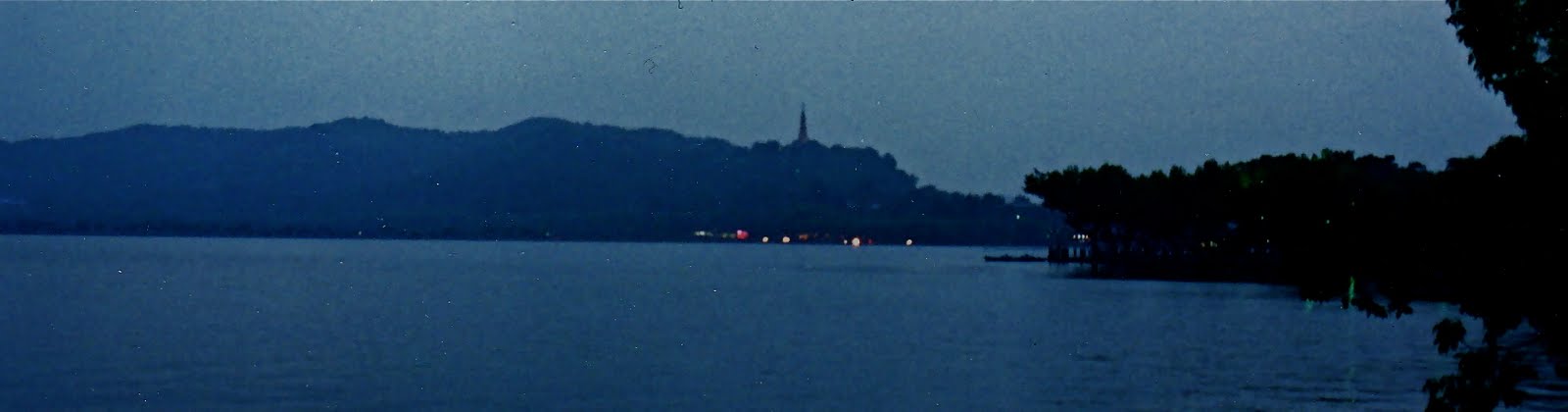
While I’m still in the afterglow of a short trip to China, here’s a favorite Chinese poem (despite its being not quite the right season for it). A friend and I discovered this poem years ago in an elementary school reader while exploring the old schoolroom in the marvelous Chinese settlement of Locke, California, in the Sacramento River Delta region. The poem was given no authorship or translation attribution in the reader, and despite much looking I’ve been unable to find it reproduced anywhere else. It’s clearly about Hangzhou’s famous West Lake, but that’s all I know about it (and would be deeply appreciative should anyone happen to have additional information on the poem’s source).


AUTUMN NIGHT AT WEST LAKE

Su Dike goes sidewise;
   Pai Dike stretches crosswise.
It’s like a rainbow sidewise;
   It’s also like a rainbow crosswise.

The moon is misty from the Rainbow Bridge.
   The bridge is like a bow;
   The moon is like a bow.

Shadows of two green hills fall to the east of the bridge –
   A high peak in the south,
   Another high peak in the north.

In the haze of autumn the two peaks are vague –
   It is vague in the south.
   It is vague in the north.


Sunday, May 15, 2011

The Spirit of the Human Verb, Darked and Stupyfied

My previous post on Chinglish brought to mind a favorite poem from Robert Graves, who clearly appreciated a good bit of mistranslation:

¡WELLCOME, TO THE CAVES OF ARTÁ!

“They are hollowed out in the see coast at the municipal terminal of Capdepera, at nine kilometer from the town of Artá in the Island of Mallorca, with a suporizing infinity of graceful colums of 21 meter and by downward, wich prives the spectator of all animacion and plunges in dumbness. The way going is very picturesque, serpentine between style mountains, til the arrival at the esplanade of the vallee called “The Spider”. There are good enlacements of the railroad with autobuses of excursion, many days of the week, today actually Wednesday and Satturday. Since many centuries renown foreing visitors have explored them and wrote their eulogy about, including Nort-American geoglogues.” From a Tourist leaflet.

Such subtle filigranity and nobless of construccion
   Here fraternize in harmony, that respiracion stops.
While all admit their impotence (though autors most formidable)
   To sing in words the excellence of Nature’s underprops,
Yet stalactite and stalagmite together with dumb language
   Make hymes to God wich celebrate the strength of water drops.

¿You, also, are you capable to make precise in idiom
   Consideracions magic of ilusions very wide?
Alraedy in the Vestibule of these Grand Caves of Artá
   The spirit of the human verb is darked and stupyfied;
So humildy you trespass trough the forest of the colums
   And listen to the grandess explicated by the guide.

From darkness into darkness, but at measure, now descending
   You remark with what esxactitude he designates each bent;
‘The Saloon of Thousand Banners’, or ‘The Tomba of Napoleon’,
   ‘The Grotto of the Rosary,’ ‘The Club’, ‘The Camping Tent’.
And at Cavern of the Organ there are knocking streange formacions
   Wich give a nois particular pervoking wonderment.

¡Too far do not adventure, sir! For, further as you wander,
   The every of the stalactites will make you stop and stay.
Grand peril amenaces now, your nostrils apprehending
   An odour least delicious of lamentable decay.
It is some poor touristers, in the depth of obscure cristal,
   Wich deceased of thier emocion on a past excursion day.

Friday, May 13, 2011

Cool Translations of Exquisite Article


Here are a few “Chinglish” discoveries from my recent trip through southern China (plus a couple from an earlier trip), offered in the spirit of celebrating not only fine translations but the occasional poetic joys to be found in inadvertently poor ones (as well as to commemorate humbly my disastrously poor Mandarin in an impromptu speech I found myself having to give while there):


“Welcome, so do you! Your journey is more interesting.”
“Warm Prompt: This elevator has been disinfected.”
“Warm Suggested: Caution Wet Floor.”
“Protecting tree, please not shinning.”
“No explosive. No weapon. No pet. No balloon.” [Posted at the entry to a railway station]

[Items on a restaurant menu in Kunming]:

“Cook in Soy Sauce Pig Hand”
“Tingle and Hot Crisp Fish”
“Mountain Pepper Pomegranate Flower”
“Sheet Iron Bullfrog”
“The Shredded Ginger Fries the Meat”
“The Frog Embrace the Jade Pillar”
“Red Meat Insid Snow”
“The Old Adopted Mother Bitter Vegetable Flower”
“Fuck Fris Potato Silk”
“Cool Mix the Vegetables and Big Hot Pepper”
“Fuck to Fry of Small and Yellow Fish”
“Fragrant Frailty Hair Belly”
“Have a Happy Reunion the Cool Vegetables of Exquisite Article”

And finally, from an astonishingly lengthy set of rules for a hotel in a small city in Jiangxi:

“Bibulosity, bustup, and hullabaloo and other behavior which will disturb other are prohibited by the Hotel.”

(In closing - a thoughtful article on Chinglish):

Wednesday, April 13, 2011

A Time To Every Purpose Under Heaven


“And it’s a disquieting thought that not even the past is done with, even that continues to change, as if in reality there is only one time, for everything, one time for every purpose under heaven. One single second, one single landscape, in which what happens activates and deactivates what has already happened in endless chain reactions…Nothing is ever finished, everything just goes on and on, there are no boundaries, not even between the living and the dead, even that zone is quivering and unclear.” – Karl O. Knausgaard, A Time for Everything


Russian mathematician George Gamow, who counter-intuitively defined different sizes of infinity, might have considered an additional definition that could take into consideration the fact that, as a purely practical matter of our mortality, the world’s writers offer an inexhaustible abundance of riches. Still, on occasion I read a work that abruptly creates an event horizon in this infinitude, proves capable of bending the light that literature gives off to such an extent that most other novels suddenly seem - relatively speaking – dim and diminished.

I’ll risk this: Norwegian author Karl O. Knausgaard’s novel A Time for Everything (translated by James Anderson, Archipelago Books, 2008, initially published in hardcover under the title A Time to Every Purpose Under Heaven) is the most breathtakingly original and subversive contemporary novel I’ve read in years. It’s also the most unusual, with a conceit I normally would have found utterly off-putting were it not for the inextricable pull of the first page.

I fear betraying the novel by being in any way reductionist, as A Time for Everything, like most great literature, defies encapsulation. It commands both the reader’s attention and pace, offering profound pleasures and challenges that crackle along the edges of consciousness and occasionally explode into it. There is nothing cheap in Knausgaard’s novel.

The skeletal outline of A Time for Everything appears anything but promising, and in fact sounds like the melodramatic quasi-religious mystical muddle one might find in a Dan Brown book: a treatise on - of all things – angels, incorporating retellings of biblical stories interspersed with the metaphysical speculations of a fictional 16th century Italian theologian.

A number of strands tie A Time for Everything together including, as the underlying foundation, a biography of this fictional theologian, Antinous Bellori. As a young boy lost one evening in darkening woods, Bellori experiences a startling, life-changing encounter with two wraith-like angels, caught mid-meal as one of them sinks its sharp teeth into a fish plucked live from the water (this wildly imagined scene, one of the novel’s most unforgettable, rivals anything I’ve read in any literature for sheer impression and impact). Transformed, Bellori pursues a life-long obsession with these mesmerizing entities through an intellectual and theological inquiry that eventually results in publication of his obscure treatise, On the Nature of Angels – a book all but lost to time, like any number of those dusty volumes that line the endless shelves of Europe’s old libraries. The narrator identifies Bellori as belonging to that new race of early modern intellectuals like Pascal, Descartes, Bruno and Newton, whose solitary, tormented pursuit of knowledge opens the world while at the same time expanding its sense of loneliness and revealing “the horror” of reason’s “step into infinity,” that, once taken, reveals “no way back.”

A Time for Everything leads us exactingly through Bellori’s philosophical exploration into the nature of angels and their curious appearances in scripture. Who are they? What are they? Why do they suddenly appear without explanation in the Bible? What relation do they have to God and to humanity? Are they living or dead? Material or other? Are they perhaps a kind of negative of human beings? Direct representations of God or separate celestial colleagues? Emanations of God’s volition or independently-willed creatures? Why do they only reveal themselves when they do, and why only to certain persons? Rather than allowing these questions to come off as ponderous (or for that matter, ridiculous), Knausgaard manages to make Bellori’s line of inquiry engrossing not simply in its application of an empirical approach to biblical accounts (that A Time for Everything occasionally inspires a sense that one might be reading a peer-reviewed study of angels is enough to pull one out of Knausgaard’s seductive prose for a blinking moment of rational re-orientation), but also in its rigorous lesson in critical reading, using that bestselling text in the western world, the Bible – more specifically, its various, curious mentions of angels, seraphim, cherubim, and the like. These Knausgaard plumbs deeply and reconstructs into daringly imagined stories. What at times appears to be a theological inquiry – and it does, on that level, raise broadly stimulating, provocative questions about the relationship between the divine and the human, the immanent and the corporal, God’s omniscience and omnipotence, and the multivariate modes of human inquiry – is also a daring plunge into the glaring lacunae of the biblical accounts.

When the narrator abruptly departs from Bellori’s biography to lead us into the first of these retellings – of the story of Cain and Abel  - what appears in the Bible as a tale tossed off in a mere two lines is spun out into a hundred pages of narrative, the first page of which finds the brothers inhabiting a wide valley ringed by snowy mountains and boreal forests. Someone is wearing black trousers, a white workshirt, red spats. What’s going on here?

We appear to be in Norway, perhaps in the 19th century. We’re most certainly not in ancient Mesopotamia. Why, given such a careful reading and questioning of the inconsistencies, contradictions and narrative holes in the Book of Genesis, are we suddenly thrust into a retelling so manifestly incongruous with anything suggestive of the Old Testament Middle East?

Knausgaard prods us to flesh out the biblical scene – cognizant that in order to do so one is almost wired to use his or her own referential context and that, in any case, one of the powers of myth is its ability to reconstitute itself in new guises. The biblical version gives us so little to go on – asks us to accept a story on great authority with almost no evidentiary detail while “cloth[ing] everything beyond the immediate in anecdote” – that to envision such a story as grounded in the actual lives of human beings demands a far greater accounting, a filled out context for being able to make sense of the divine Word in concrete human terms. To do this, Knausgaard takes the charge and runs at light speed. These retellings are stunning in their richness of detail, their vivid rendering of the characters, and in the astonishing vitality with which he relates these tales, which are full of glints of light, shadowy movements among the trees, the rush of rivers and the lavations of rain, of gestures, glances, intimations, the myriad ephemeral elements that mark and hold the present in glorious abeyance for an instant. Picking up A Time for Everything and opening it at random, one finds this numinous sublimity of the present throughout:

He turns and glances over toward the houses lying beneath a hill on the side of the field, and he sees that the figures, at this distance little bigger than beetles, will soon be home…And it’s as if they’ve held him captive, for only now, now that they’re no longer there, does the landscape he’s been in all day long reveal itself to him…The undulating cornfield with its grayish, dusty surface glimmers almost golden in the sunshine. The lush crowns of the trees that grow between the field and the encircling mountains on the opposite side of the valley form one single band of green, on the slope close to him one could pick out individual species: aspen, alder, oak, willow, pine, spruce. The small unique habitats they each support. The jutting ledge beneath the pine covered in places with dry, green moss, in others bare and bluegray, everywhere carpeted in yellow pine needles. The blooming rose-hip thicket that nestles close, the air above it heady with bumble-bees and wasps. Its roots reaching serpentinely across the mountain only to disappear into the earth nearby. The straight pine trunk blushing in the glow of the evening sun, the shadow it throws cross undergrowth and bushes, up across the hillside. The grassy bank below still flecked with wintry yellow, the barely year-old saplings that grow there, delicate and seemingly uncertain, as if they’ve ventured onto an ice that is so thin that they don’t dare to go on, or have the courage to turn and retreat to the safety of the forest, but must simply stand there motionless and wait until someone comes to rescue them.

Fiction can obviously do what a religious text like the Bible cannot, and as literature, the passages in the Bible that provide material for A Time for Everything come up embarrassingly short compared to Knausgaard’s luminous, expansive incarnations (A Time for Everything should find a secure place in those standard undergraduate course offerings on “The Bible as Literature”). But to imagine that A Time for Everything is a book specifically about this religion or this holy book would, I think, be to miss its larger scope. It is not simply an attempt to reinvigorate biblical tales, which it nevertheless does astonishingly well while pushing beyond the way that, for example, Roberto Calasso revived Greek and Hindu myths. Neither is this one of those works like East of Eden that employ biblical elements to add depth and mythic resonance to a contemporary tale. Nor does Knausgaard take a mere deconstructionist approach to these stories. If anything, his is what might be called a supraconstructionist approach, taking the grain of these tales and causing them to effloresce, spinning from the thin strands of their DNA a whole living world. Recapitulating biblical myth - by extrapolating, from these familiar tales told in the Bible via a few cursory and authoritarian bare-boned lines, lengthy narratives with flesh - is nothing new (as anyone who’s ever been to a Sunday sermon at an AME church can readily attest), but this is no evangelically-motivated attempt at enrichment. I can recall few novels that offer anything approaching the unexpectedness in Knausgaard’s reinventions. His retelling of the story of Cain and Abel is not simply an imagining of it in a humanly comprehensible setting, but a profound questioning – in completely unexpected directions - of murder and transgression. His retelling of the story of Noah and the ark likewise spares nothing in his insistence that we be charged with envisioning the reality represented by the myth: the crazed eccentricity of Noah’s obsession, the geological and ecological impact of a world covered in billions of tons of water (oh, and about those creatures of the sea?), and the heartlessness with which Noah had to have abandoned those left to drown, depicted in a scene made powerfully incarnate by the matter-of-factness with which the waters’ rising around a mother and child is recounted. Despite its flirtations with the immanent, A Time for Everything is a strikingly physical, body-centered novel. Knausgaard fleshes out these stories literally; their flesh-and-blood grounding involves occasionally shocking attention to the body.

Taking instances of angels’ appearances in the Bible and examining them in the manner that science has treated of physical phenomena, Knausgaard brings rationalism to bear on an ostensibly irrational phenomenon, approaching spiritualism head on with rationalist tools - not to dismantle it, but to establish a line against which it must be argued. A Time for Everything subverts fundamentalism by making a fundamentalist interpretation of the Bible impossible in light of the empirical, in light of the evidence provided by the Bible itself. A question never far away is these tales is: how do we know what we know? When Noah’s sons see their father for the first time following his discourse with God, the narrator asks of one of them, “What was he actually seeing when he looked at his father?” This is a question that runs throughout Knausgaard’s novel: what are we actually seeing when we look at a character? When we read a text? When we accept as sacred a religious book like the Bible?

It is almost as though Knausgaard has set out to turn these religious founding documents on their head, and by so doing perform a sort of exorcism of fundamentalism. The radicalism of A Time for Everything lies in its firm insistence on the precariousness of rationalism, that at the dawn of the Enlightenment modes of inquiry into science and into religion (a treatise on angels, for example, in the case in point) were on a more or less equal footing, and that, given different circumstances, the latter might easily have dominated the former, leading to a completely different world. In one particularly engaging scene, the young Noah (envisioned as a precocious albino savant who cannot withstand the sun) tries nightly to work out a system for categorizing the world, a kind of rudimentary scientific method that harkens back to Knausgaard’s observation at the beginning of the novel that the world might easily have chosen to prioritize a religious inquiry such as Bellori’s theories of angels over the scientific method that gave us the Age of Reason. A warning about the fragility of human systems is implied, that the Dark Ages might well have continued and can always return (a not insignificant point in a world where religious fundamentalists and fanatics continue to attack inquiry and openness through denunciations, fatwahs, censorship, general anti-intellectualism, and even violence and terror).

Given the ambitions of A Time for Everything, it’s somewhat surprising to find, in place of ponderousness, a consistently scintillating narrative replete with wry humor, never condescending but at times almost teasing, good-naturedly pointing out contradictions and raising common-sense questions about biblical tales more often than not taken for granted (when they’re not in fact being taken literally). For example, when the angels arrive in Sodom, they are met by Lot, obsequiously waiting at the city gates like a typical tourist tout to entice visitors to lodge at his home. The scene as presented by Knausgaard has an element of hilarity to it:

The dust swirls about his feet. Even though he holds his robe above his knees with one hand, he’s so eager that he almost trips several times. And when he throws himself on the ground before them, he’s so out of breath that at first they can’t make out what he’s saying.

“Yoo-hoo, sirs, yoo!” Is what it sounds like. ”Yoo-hoo, sirs, yoo!”

At the same time, one never gets the impression that Knausgaard is baiting his readers; his encyclopedic knowledge of not only the Bible but also a whole range of Judeo-Christian theology makes that nearly impossible. He’s grounded as a good scientist is - in empirical inquiry refined into assertions that set a new bar for being challenged – yet never loses sight of the fact that he is first and foremost engaged in a literary enterprise, and an exceptionally rewarding one both in terms of the breadth and the captivating liveliness of his imagination.

The novel ends on a note of deliriously high humor – or almost. Reaching the last line of the novel I wished there had been a blank page inserted between it and the subsequent, deeply confounding “Coda,” which, left unread, would make A Time for Everything a different book than it is. In fact, in choosing to provide a coda to a story that ends as it does, Knausgaard provides us two novels, one for romantics and another for realists. This pointedly troubling section is a radically bracing departure from the rest of the novel (readers may be advised to pause before continuing with it). From one point of view, the coda – in which we encounter the book’s anguished contemporary narrator, a writer seeking solitude on a barren, isolated island off of Norway’s coast - seems entirely superfluous and unnecessarily complicating. In addition, despite the narrator’s vow to eschew self-absorption, the coda has the effect of being full of just that, almost a way of drawing attention to the struggles Knausgaard himself must have gone through in order to produce this rich, meticulous and vastly researched book (and if  A Time for Everything offers irrefutable testimony to the novel’s not being dead, it also resurrects the long dormant figure of the tortured artist). But from another point of view the coda provides the novel its most trenchant meaning, identifying at last its narrator and situating him in the contemporary world where angels have devolved from the incandescent entities they once were through various diminishing stages of incarnation into a form that has pretty much nothing to offer to anyone anymore, where the role they played in the stories of the Bible, as powerful intermediaries between God and humankind, no longer has meaning, and where even an attempt at awakening as extreme as the writer’s self-inflicted desecration of his own body (as though he could inscribe directly into the flesh a sense of significance) reveals him in a state of torment, bereft of the richness of meaning and assurance the world of faith and belief once provided, left only with the raw struggle to create.   

A Time for Everything is not a difficult novel, but it demands patience and careful attention. While the retellings of the biblical stories in which angels appear unwind with the delicate, measured pace and exquisite attention to detail that mark the best kind of storytelling, the interstitial explorations of theological questions require more diligent reading. However, Knausgaard’s forays into philosophy and theology in his ambitious work keep a steady, artist’s eye on the fact of A Time for Everything’s being a work of fiction. And as novels go, it is daring, thrilling, infinitely rewarding fiction of the highest order, playing among the angels where they themselves might fear to tread.